Unknown's avatar

About Peter Rutland

I a Professor of Government at Wesleyan University in Middletown, Connecticut. My main research interest is Russia and the former Soviet Union, but I teach a course on nationalism around the world. This blog is connected to the course I teach. It includes links to new articles on recent developments where nationalism is shaping political events.

Pussy Riot and the Russian Tradition

The Moscow Times just published my article on Pussy Riot:

What Links Pussy Riot With Dostoevsky

26 August 2012
By Peter Rutland

The dramatic trial and sentencing of the Pussy Riot band members captured the imagination of Western observers but has not resonated so much at home. Why has the band been so successful in gaining international attention, and what is the long-term historical significance of the Pussy Riot phenomenon?

Behind their punk Western image, it is important to recognize that Pussy Riot emanates from a long-standing tradition of dissent by the Russian intelligentsia. To borrow a Leninist term, Pussy Riot is Western in form but Russian in content. The Western-derived medium of a punk performance is delivering a very Russian message.

One obvious lesson to draw is the disruptive potential of the Internet. If a picture is worth 1,000 words, then in the age of YouTube, a video is worth 10,000. The striking images of colorfully dressed women dancing in front of the ornate gilt altar of Christ the Savior Cathedral — the country’s crowned Orthodox jewel — against a curious but ear-catching soundtrack, proved irresistible to global audiences. It spawned copy-cat action in a Cologne cathedral, demonstrations of support in dozens of cities from Marseilles to Sydney, and expressions of sympathy from the likes of Madonna and Paul McCartney.

The all-thumbs Russian government added fuel to the fire by arranging a clumsy show trial that culminated with the women sentenced to two years of corrective labor for “hooliganism motivated by religious hatred.”

Pussy Riot succeeded in drawing global attention to the cause of human rights in Russia in a way that dozens of reports of the beatings and killings of journalists, or the cruel death of lawyer Sergei Magnitsky in pretrial detention, had failed to accomplish. Just 41 seconds of tape, lengthened to three minutes by the addition of material recorded elsewhere, succeeded in undoing the Kremlin’s multimillion-dollar program to boost Russia’s soft power and its global image.

Much more interesting than the band’s antics in the cathedral, however, were the closing statements that the three defendants delivered to the court, which New Yorker editor-in-chief David Remnick described as “a kind of instant classic in the anthology of dissidence.” Each woman took a different theme. Yekaterina Samutsevich dissected the unhealthy fusion of church and state. Maria Alyokhina talked about the deficiencies of the country’s education system and the suppression of the individual. Nadezhda Tolokonnikova offered a critique of the “autocratic political system” in general and the conduct of their prosecution in particular.

The statements portray a society that is passive and disoriented in the face of an all-powerful ruling bureaucracy. Their critique is spiritual rather than material, and they are not particularly interested in leveling accusations of corruption, which have been the central theme of the mainstream opposition.

Many Russian observers have been dismissive of Pussy Riot, characterizing their provocative actions, including previous performances of a sexual nature, as infantile and offensive — and unpopular with the public at large. But it is not at all clear whether Pussy Riot expects or even desires a groundswell of public support. They do not aspire to be leaders of a revolutionary movement, either Orange or Leninist.

Rather, their appeal for truth and freedom puts them squarely in the tradition of the 19th-century Russian intelligentsia. Tolokonnikova directly referred to the group’s punk antics as equivalent to the truth-telling “holy fools” of centuries past and embraced the idea that their prison sentence proves the virtue of their cause.

Pussy Riot adopted the tactics of protest from the Situationists of 1960s France, the punk rockers of 1970s Britain and the feminist Riot Grrrls in the United States in the 1990s. The idea of donning masks comes from the movie “V for Vendetta,” which was popularized by the Occupy movement.

But the strategy of Pussy Riot has a deeper foundation. Their moral critique of authority and appeal to a higher truth is rooted in pre-revolutionary Russia, a tradition that fitfully resurfaced during the Soviet years. They cite 19th-century literary critic Vissarion Belinsky and Fyodor Dostoevsky, but not Voltaire, John Stuart Mill or other representatives of the Western liberal tradition.

The assertion of an individual’s right to exist — what Alyohkhina refers to as “inner freedom” — is not a problem for young people living in the West and has not been for a century or more. Whatever the shibboleths that are evoked by today’s Western radicals — such as capitalism, neoliberalism, Empire and racism — they are phenomena quite different from the challenge posed by the authoritarian Russian state.

There are, of course, many points of overlap between Pussy Riot and their Western supporters. They both want Russia to respect human rights and allow free elections. But even if Western pressure succeeds in freeing the band members, it is unlikely that Pussy Riot will be able to leverage their Western support into concrete political gains. Like their 19th-century counterparts, they will be on their own, which does not mean that they will not eventually be victorious.

The lessons for nationalism of the London Olympics

The London Olympics turned out to be an unqualified success, to the surprise of nearly all observers. What can they teach us about the dynamics of nationalism?

The Olympics present an unparalleled opportunity for countries to indulge in a display of nationalism on an international stage. They represent the acceptable face of nationalism – “good nationalism” – in contrast to its usual associations with xenophobia, ethnic conflict, war and genocide. The Olympics has been what Isaac Souweine describes as “nationalist theater” since its inception. He writes that “In the first London Games (1908), athletes marched into the stadium behind their respective flags; though not before the English and Russians tried to prevent the Irish and Finns from displaying their colors. The nationalist symbology of the Games would not be complete, however, until the first Los Angles Games (1932) introduced the now familiar victory ceremonies in which medal winners stand on a victory podium while flags fly and anthems play.” It was also tinged with racism – the International Olympic Committee originally explained that the colors of the five rings (blue, red, yellow, black and green) represented the five continents. In 1951 it changed its story, saying the colors were merely taken from national flags.

The Olympics build a sense of national pride and unity, a distraction from economic difficulties and from ethnic, regional and sectarian divisions. While it is nice for a country like Jamaica to get some international recognition for the success of its sprinters, the most important audience is the one back home. The effect is particularly marked for the host country itself.

Beijing and London present an interesting comparison. China was a newly emerging power that used the 2008 Games to announce that it had arrived as a modern successful power. They not only organized a flawless games, but also topped the medals table with 51 gold to the US’s 36 (though the US was stil ahead in total medals, by 110 to 100).

In contrast Britain was a disoriented, aging, fallen power that used the 2012 Games to demonstrate that it still had something to teach the world. It became clear from the outset – with Danny Boyle’s stunning opening ceremony – that hosting the Olympics gives the home country a unique opportunity to project itself on the international stage. A patriotic delirium descended across Britain. This atmosphere was nurtured by a skillful campaign that went way beyond the ceremonies in the main stadium. Prior to the Games, the Olympic torch went on a lengthy and sinuous tour of United Kingdom, creating a multitude of media opportunities to highlight local communities – and serving to connect them to the national Olympic project. After the Games, someone came up with the idea of painting mailboxes gold in the home towns of medal winners.

What was interesting about London was that it showed how a country can seize the unique occasion to redefine itself – not merely to replicate traditional symbols of identity, but to innovate in a way that seems likely to have a lasting effect on public perceptions at home and abroad. 23 million Britons watched the Opening Ceremony, along with a global audience of one billion, and as Simon Kuper argues it offered a comprehensive rebranding of Britain as an easygoing, multicultural and cosmopolitan project, far removed from Thatcher’s military prowess (in the wake of the Falklands) and Tony Blair’s inchoate high-tech vision.

Olympic nationalism is not free of contradictions. The downside was illustrated by the 2004 Athens Games – a poorly organized event can showcase the host country’s deficiencies; just as back in 1980 the boycott of the Moscow Olympics drew attention to the Soviet Union’s international isolation. A poor showing in the medals table can ignite national doubt and a search for scapegoats, and occasionally inter-national rivalries do surface at the Games (see following sections).

Increasingly, nationalism at the Olympics finds itself in competition with commercialization. Alongside the national flag, each athlete must wear the brand of their equipment gear sponsor, while the events themselves were saturated with advertisements for the main corporate backers. Eleven corporations (Coca-Cola, McDonald’s, Visa etc.) paid $100 million each over a four-year period, in return for which they had exclusive rights to display their brand at the Games. Activists in India and Vietnam – along with the AFL-CIO – protested the presence of corporate sponsors such as Dow Chemical and Rio Tinto Zinc. The role of corporations is redoubled after the games, when medal winners can expect lucrative sponsorship deals. The IOC itself is the worst offender for commercialization, aggressively protecting its right to use of the Olympic symbols – as in the case of the English butcher forced to take down sausages shaped to form the Olympic rings.

The significance of the medals table

It is not only the host country that plays the Olympics for nationalism – every participant’s team wraps itself in their respective flags. All 204 countries and territories that participate in the Games seize the chance to have their moment in the international arena, even though 73 of them have never won a single medal. In 2012 Grenada won its first ever medal – a gold in the men’s 400m, while Montenegro won its first with a silver in women’s handball, causing no doubt jubilation in Podgorica. Particular attention is focused on team sports, which directly pit nation against nation, even though they do not count for much in the aggregate medals table.

A great deal of national pride hangs on one’s ranking in the medals table (traditionally the IOC uses golds as the main ranking, while the US uses total medal count). Despite finishing in second place with 38 gold and 88 total medals China was disappointed by its overall performance: anything after Beijing would be a let-down. Individual failures were taken hard: the New York Times reported that “A weightlifter sobbed on national TV that he had ‘disgraced the motherland’ for only getting a silver medal.”

The worst performer, as measured by number of medals compared to size of population or GDP, was India, who won a mere six medals, including two silvers. Brazil, the 2016 host, did not do so well either, winning 17 medals, of which three were gold. South Korea was very happy with its 13 golds. A  Korean newspaper helpfully produced a world map showing each country’s size adjusted for their medal count. With its sixth place finish, this exercise made Korea much more visible on the map than it is based on territory alone.

Even finishing first is not, apparently, enough for some US observers. President of the Council on Foreign Relations Richard Haas took the results as evidence that US hegemony is eroding, since her 104 medals represent only 11% of the total – but he took some comfort from China’s medal count was down from its Beijing peak. Meanwhile Fox News was complaining that the Olympics were not patriotic enough, criticizing the gold-winning gymnast Gaby Douglas for wearing a pink leotard and not stars-and-stripes colors.  

If there was a gold medal for buck-passing it would be won by Russian Sports Minister Vitaly Mutko. Mutko complained of cheating by boxing judges, and he blamed health and education ministries for not cooperating with his ministry. Russia finished in fourth place with 24 golds (behind Britain with 29), and third in total medals with 88. This is impressive given Russia’s 142 million population, but still its worst performance since the Soviet Union first entered the games in 1952. And this came in the wake of Russia’s dismal 11th-place finish at the 2010 Winter Olympics in Vancouver. Had there still been a unified team with all the former Soviet states, it would have won first place in London– with 46 gold and 155 medals.

Home country advantage

There is of course a literal home country advantage – the host nation tends to win 50 percent more medals than it did in previous Olympics. Britain saw its gold total rise from 19 in Beijing to 29 in London – a third place finish. In Seoul in 1988 South Korea won more gold medals than West Germany and landed in fourth place in the medal count. Likewise Australia placed fourth in Sydney in 2000. Somewhat ironically, given the super-charged patriotism of the US, the one case where there was no host-country boost was Atlanta in 1996.

There are various explanations about why this occurs. One obvious factor is that host countries pour a lot of money into building up their own sports teams to ensure a good showing. The UK had stepped up its spending on Olympic sports, using funds from the National Lottery and other sources, after its dismal performance in the 1996 Atlanta Games. In recent decades China has developed a comprehensive national strategy of selecting and training promising athletes from a very young age.

It might also be supposed that enthusiastic support from the home crowd may boost the athletes’ performance. However, an alternative explanation was offered by Nigel Balmer of University College London in an interview with NPR. Analyzing performance in different types of sports, Balmer concludes that the home country advantage is heavily concentrated in subjectively measured sports like gymnastics, diving and dressage, and is barely found in sports where there is a clear objective winner, such as track or swimming races. He surmises that the judges are being swayed by the home crowd.

A break from politics?

In the original ancient Olympics, warfare was suspended for the duration of the Games. During the modern Games, to some degree there is a suspension of partisan politics (both domestic and international) – something that clears the air for displays of feel-good symbolic unity.

There were only a handful of minor examples of politicization during the London Games. Queen guitarist Brian May got into trouble with the English hunting lobby for wearing badges of a fox and a badger. In the run-up to the Games, there was outrage in the US Congress that Team America’s Ralph Loren uniforms were made by Team China.

A South Korean footballer was stripped of his gold medal after he held up a sign following South Korea’s 2-0 victory over Japan, claiming South Korean sovereignty over the Dokdo/Takeshima islands. The Korea Times reported that angry bloggers flooded the web with anti-Chinese messages after it was falsely reported that a Chinese judge had disqualified a Korean swimmer. When the North Korean football team marched onto the field before a first-round game against Colombia in Glasgow, the stadium’s video boards flashed an image of the South Korean flag. The North Koreans turned and left the field.

Which sports are included?

The question of which sports to include in the Olympics in the first place is itself a hotly contested issue. Brining a new sport into the Games can boost national pride – and increase an outsider nation’s medal chances if they throw resources into that sport.

The advent of judo at the 1964 Tokyo games was the first time a non-European sport was accepted by the Olympic community. Others followed, such as Korea’s taekwondo and more recently the Japanese paced-cycling event known as keirin (both added in 2000). (To qualify, a sport must be practiced in at least 75 countries in four continents.) Baseball and softball were added in 1992, then dropped in 2012 because of the US dominance in these sports. Golf and rugby were discontinued but are coming back in 2016. Indians complain that cricket is still excluded, while China is lobbying for the martial art of wushu.

The Olympics Opening Ceremony: A triumph of soft nationalism

Once every four years, the Olympic Games provide an opportunity for nationalist grandstanding on a world stage. The London Games are no exception. On the contrary, filmmaker Danny Boyle stunned the estimated one billion viewers around the world with an exuberant and creative opening ceremony.

Observers had been skeptical that Boyle could match the precision and panache of the 2008 Beijing opening spectacle. Boyle’s “Isles of Wonder” had a similar structure to that of Beijing, showcasing the national narrative of the host country, but it was sharply different in tone, relying on rock music and theatrical imagination rather than a multitude of synchronized gymnasts. The high point was the videosequence of the Queen accompanying James Bond on a helicopter and then ‘parachuting’ into the stadium. (Though one writer in the Daily Mail did complain that “the entire institution of monarchy has been reduced to a subsidiary of the reality-TV entertainment industry.”) Boyle skillfully used the River Thames as a metaphorical anchor for the flow of historical time.

One criticism of the performance was that it included too many obscure references to British culture and history. The extended paean to the National Health Service seems to have caused the most puzzlement amongst foreigners. This segment also drew the ire of a number of British conservatives, with Tory MP Aidan Burley describing the show as “leftie multicultural crap.” According to one report, when the Cabinet was shown a short video outlining the script last January, the education minister raised some objections, asking for example that Churchill be included. (He was indeed included in the final version.)

Labour MP Tristram Hunt more generously suggested that instead of grumbling about this “£27m party political broadcast,” conservatives should thank Boyle for the most gifted celebration of the Act of Union in a generation.” He went on to add that “while the right has won the economic arguments, the left took victory in the culture wars.”

One Nation?

In general, the extravaganza is being hailed within the UK as a triumph, capturing the national essence at a time when British identity is very much up in the air. The British national narrative has never really recovered from the loss of empire. Without empire as a unifying theme, the outlying components of the Union – Scotland, Wales and Northern Ireland – have become more assertive. Britain has singularly failed to embrace the European project. The arrival of millions of ethnically and religiously distinct immigrants led to the embrace of multiculturalism as a central theme in British identity, but in the wake of the 9/11 and 7/7 bombings there has been an ongoing debate over the limits if not the very viability of multiculturalism. And lingering throughout these identity wars are the enduring class and regional divides that have polarized British society for centuries.

Boyle’s masterpiece brilliantly transcended these divisions, presenting a story that had something for everybody. The ceremony is being hailed by some as a “Diana moment”: a reference to the unique outpouring of emotion and sense of national belonging that occurred following the untimely death of Lady Diana in 1997.

Boyle was consciously trying to weave together a national narrative of progress and inclusion: moving from a rural idyll; through the turmoil of industrial revolution, war and depression; to technological innovation and socio-cultural flowering. The age of empire was notably absent from his story, until the arrival of the Windrush ship bringing the first wave of post-war Jamaican immigrants.

Boyle’s intellectual inspiration was apparently a compilation of essays on the arrival of the Machine Age assembled 60 years ago by Humphrey Jennings, and entitled Pandaemonium. In the review cited above, Hunt sees its origins in JB Priestley’s 1934 work, English Journey, in which Priestley spoke of three Englands: the “real, enduring England” of the countryside, the industrial England, and the modern urban scene of cinemas and dance halls.

More than one observer noted the parallels with a speech from the movie “Love Actually” (which is rather bad, actually).  Hugh Grant, playing the prime minister, explains that Britain is still a great nation because it is “the country of Shakespeare, Churchill, the Beatles, Sean Connery, Harry Potter, David Beckham’s right foot. David Beckham’s left foot, come to that.” All of those characters were central to Boyle’s narrative – except Churchill. (The Hugh Grant speech is in turn reminiscent of Orson Welles’ summary of Swiss identity in The Third Man (1948) – except Welles was being ironic.)

Foreign reactions

The Financial TimesJohn Mcdermott made the interesting comment that “foreigners have a right to ask, wasn’t this all a little parochial? Yes, but it was a universal form of parochialism.” This is a neat summary of one of the main contradictions of nationalism. Each nation sees itself as unique, but realizes that, by extension, every other nation probably sees itself as unique too. So true nationalists should be internationalists, and be willing to share in each other’s national uniqueness. To paraphrase Leo Tolstoy, every unhappy nation is the same, but each happy nation is happy in its own way.

The BBC and Telegraph reported that the show got generally positive views from around the world for its humor and informality. In the words of an email from Yidan Tan, a Chinese graduate student studying in England: “The London Olympic Ceremony well represented British culture and history and their contribution to humanity with typical British style and humour. The most important point I admire, which makes it better than the Beijing Ceremony, is that it strongly expressed and reflected precious values, including humanism, equality, freedom, pluralism, and was full of respect for individuals and ordinary people. That’s what China lacks today and what we must learn from and improve.” Official Chinese media said it was “spectacular and “very English.” One Chinese entrepreneur has already contacted a British impresario, hoping to bring a theater musical version of the show to China.

Russian Prime Minister Dmitry Medvedev told a TV interviewer he enjoyed the ceremony very much and said it provided an important lesson for the Russians planning the 2014 Sochi Olympics. In addition to the humor, Medvedev singled out the emphasis on British rock music, which he noted is well-known in Russia and serves as “a language of communication with a wide circle of people” Medvedev’s positive vibe was shared by other Russian commentators.

Sarah Lyall of the New York Times liked it, as did her fellow columnist Alessandra Stanley, even though she dubbed it “a Bollywood version of a sixth-grade play.” Maybe she was not listening closely enough in sixth grade: Stanley misidentified Isambard Kingdom Brunel (portrayed by Kenneth Branagh) as a Dickens character. Stanley was not the only one to fail the British history test: the NBC commentators on American TV could not identify Timothy Berner Lee, the inventor of the World Wide Web. The NBC crew also did a spectacularly bad job in mangling the national sensitivities of the participating nations as their athletes marched into the arena, with African countries in particular getting the most cavalier treatment.

State-branding in Connecticut: commerce and politics

Connecticut has just unveiled a new $27 million campaign to attract tourists to the Nutmeg State, complete with a stirring video, which seems to be channeling Cold Play. The official slogan of the campaign – devised by a New York City advertising agency – is “Connecticut, Still Revolutionary.” This may puzzle many Americans, who are more likely to associate the 1776 Revolution with Massachusetts, which is where it all began.

Connecticut does of course have its own revolutionary heroes, most notably Nathan Hale, a spy who was caught and hung by the British in 1776 at the age of 21, and whose last words were “I only regret that I have but one life to give for my country.”

Perhaps, what the campaign has in mind by “revolutionary” is not so much men in tricorn hats, as subsequent revolutionary thinkers and innovators who resided in the state, such as Mark Twain, Samuel Colt and Igor Sikorski (the inventor of the helicopter).

Connecticut tourism director Randy Fiveash explained that as a result of focus groups held in Philadelphia, New Jersey, Boston and Austin, “We found that Connecticut was not on people’s radar. We needed a rallying cry, a vocabulary.” It is now routine for states to launch public relations campaigns to attract tourism, a major source of jobs and tax dollars (“destination branding”). More broadly, states compete to attract investors who will bring manufacturing and research jobs.

The trail-blazer was the “Virginia is for Lovers” campaign, launched in 1969, whose success spawned the “I love New York” logo a decade later. Kentucky invokes “Unbridled spirit;” while Colorado has a “Come to Life” motto, next door to “New Mexico True.” The latter may allude to the fact that some Americans think New Mexico is still part of Mexico – the state’s tourism monthly has a column where their readers can report such incidents. A $28 million “Pure Michigan” campaign reportedly produced a three-to-one return on dollars invested in increased tourism visits. Here is one of the award-winning Michigan ads, and here a parody.

These modern campaigns have their precursor in the state of Vermont, which back in the 1930s tried to revive a stagnant economy by wooing weekenders from New York City with pictures of a bucolic idyll. In Vermont this also involved branding and marketing the state’s dairy produce. For an update on the Vermont brand, see this 2003 report. In recent years the rise of ‘locavores’ advocating locally-grown or raised food has led to a revival of state-branding of food products. Food and tourism can be combined, as in the sinister-sounding “100 Dishes to eat in Alabama before you die” campaign.

The persistence of strong state identities in the US is something that often surprises foreigners, who see the US as a powerful, unitary state with a strong and unambiguous political and cultural identity. They are puzzled to see identities emerge in mid-western states such as Iowa, which were just squares on a map draw in the 19th century. (Sorry, Iowa!) This seems to be vivid evidence for Benedict Anderson’s notion of the nation – or in this case, the state – as an “Imagined community.”

But it is important to remember that the 13 colonies had already developed strong and distinct identities before they pooled their sovereignty in forming these United States. In the bloody civil war waged just 150 years ago to preserve that union, men fought and died in units that were recruited from the respective states. (See Matthew Warshauer’s excellent new book, Connecticut in the American Civil War.) And only after the Civil War did popular usage switch from the plural to the singular, talking about “the United States” as opposed  to “these United States.”

In every political community, federal or not, identity is necessarily hierarchical, with several levels of belonging. People want a local identity, a sense of place, at the same time as they have a national political identity. Even France, with its clearly-defined universal political creed, is a nation with famously distinct local culinary cultures. (As Charles de Gaulle remarked, “How can anyone govern a nation that has 246 different kinds of cheese?”)

I will address the topic of nation-branding in my next post.

APPENDIX – TOP TEN MOVIES ABOUT CONNECTICUT

Connecticut’s image has not been particularly helped by Hollywood. Only a small number of movies have been set here, and many of them seem to involve suburban family crises:

The Stepford Wives (2003)
The Ice Storm (1997)
Amistad (1997)
Far From Heaven (2002)
Revolutionary Road (2009)
Mystic Pizza (1988)
Stanley and Iris (1989)
PCU (1994)
Christmas in Connecticut (1945)
Indiana Jones movies (The classroom sequences are set at Yale.)

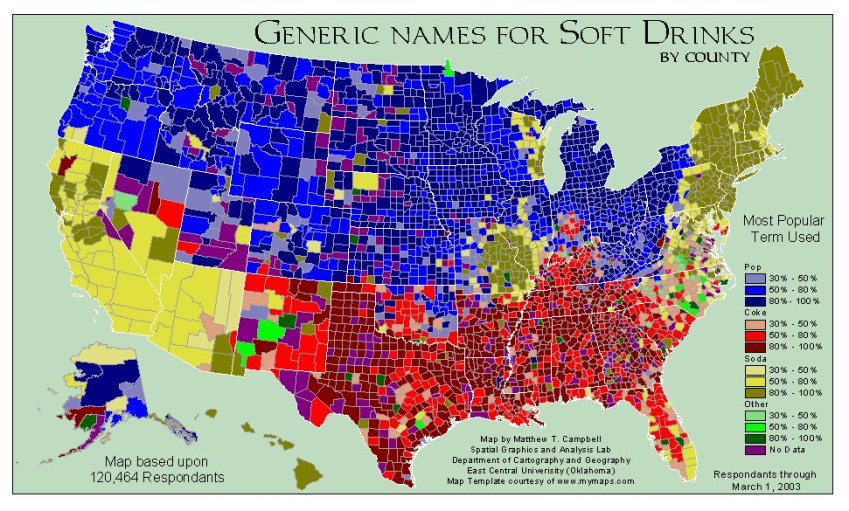
Coke vs Pepsi: Soda and national identity

This fascinating map recently came to my attention. It shows the strong regional differences in the way Americans refer to ‘soda.’ There is a large ‘pop’ zone extending across the mid-West, while the South is ‘Coke’ country – appropriately enough since Coca-Cola is based in Atlanta. California is a soda zone, and there is a curious cluster of soda-speakers around St. Louis Missouri.

In the map pop is blue, coke is red and soda is yellow/green.

Coca cola would have liked everyone to be singing on the same page, but its bid for global hegemony has failed.

Many countries around the world have proudly defended their indigenous colas. Examples include Inca Kola in Peru (actually founded by an Englishman in 1935).

In Russia the Ni Kola (No Cola) company has been marketing kvas, a traditional non-alcoholic beer type drink, as an anti-American beverage.

This ad shows what happens when Dad returns home having started to drink Coke. The expert says “No to cola-nization. Kvas is the health of the nation.”

In this ad the man, speaking in bad Russian, lists the benefits that the US has given to the world, and says that kvas is uncivilized.

India saw the introduction of Thums Up cola in 1977 after Coke gave up trying to market its own products in the face of protectionist barriers. In 1990 Pepsi entered India, and in 1993 Thums Up was bought out by Coca Cola.This ad nicely connects Thums Up to the Durga Puja festival in Kolkata.

Coke uses Thums Up to attack Pepsi. Here is an anti-Thums Up ad from Pepsi.

I think the ad is making fun of the Thums Up commercials which show their hero doing dangerous stunts.

I addressed the question of Beer and Nationalism in an earlier post. For an update on this important theme, see this posting on beer commercials and the preparations for ANZAC Day in Australia and New Zealand.

Putin’s nationality dilemma

I just published a commentary discussing Putin’s take on nationalism in the Moscow Times. This topic is also addressed in today’s New York Times.

PUTIN’S NATIONALITY DILEMMA

In Prague, tourists line up to visit the “New-Old” synagogue, which was new when it was built, in 1270. On Jan. 23, Prime Minister Vladimir Putin published an essay on the “national question” in Nezavisimaya Gazeta. Like the Prague synagogue, Putin’s article is something that is called new, but in fact, it is quite old.

The good news was that there is no sign of Putin playing the nationalism card. Such fears were triggered by his reaction to the December 2010 clashes in Moscow between Russian and North Caucasian youth when he met with soccer fans. While calling for tighter controls on migrant workers in his article, Putin recognizes that they are here to stay, and he defends the country’s federal and multiethnic structure.

As political analyst Andrei Makarkin has noted, one important development this past year has been that many ultra- nationalist leaders have given up on trying to work with the Kremlin. Many of them have now formed an alliance with democrats and Communists in opposition to the rigged Dec. 4 elections. Several leading nationalists were given the right to speak from the tribune at the protest demonstrations. Opposition leader Alexei Navalny has often deployed nationalist rhetoric and promotes the “Stop Feeding the Caucasus!” slogan, something that Putin’s article specifically targets as dangerous for the Russian state.

Although Putin is rejecting an alliance with ultranationalists, the bad news is that his approach is a thinly disguised recycling of Soviet nationality policy. Writer Alexander Morozov has suggested that the core ideas in Putin’s article were taken from a 2010 Education Ministry proposal for promoting “polycultural” education. But they are rooted in a much deeper-rooted discomfort with recognizing the force of minority national identity. Putin’s model is a Russia-centric view that glosses over the fears and aspirations of the nonethnic Russians who make up 20 percent of the country, a statistic that was nowhere to be found in Putin’s article.

Putin argues that the traditional European nation-state is based on a closed model of national culture. This meant that the Europeans were reluctant to integrate Muslim immigrant populations. Instead they opted for a “multicultural project,” which Putin now deems a failure.

Russia, in contrast, is a “multiethnic civilization with Russian culture at its core,” a tradition, which Putin says is rooted in the “expansive Russia” of tsarist times. “Russia’s state development is unique,” writes Putin. “It is neither an ethnic state nor an American melting pot.”

Russian identity, rather, is that of a “civic nation” — one that is rooted in loyalty to the state. Putin argues that this is why Russians living in other countries fail to organize themselves as a cohesive diaspora. Putin does not use the term “Rossiisky,” which former President Boris Yeltsin was fond of using to denote civic as opposed to ethnic identity. This kind of statist nationalism is unacceptable to ultranationalists who are driven by hatred of the West as an external enemy and Muslims from the North Caucasus and Central Asia as an internal enemy.

But Putin goes on to say, “This kind of civilizational identity is based on preserving the dominance of Russian culture.” He calls upon Russian intellectuals to preserve the country’s “unified cultural code.” This can only be alarming to Russia’s minorities who have seen their autonomy steadily eroded over the past decade. For example, they have objected to the unified state exam for university entrants, which was introduced two years ago, which can only be taken in Russian.

In fact there is nothing particularly unique about Russia’s approach to national identity. All modern states try to guarantee civic rights while also resting on some common ethnic and linguistic foundation. Putin praises Russian identity for achieving “unity in diversity” — perhaps not realizing that is the official motto of the European Union since 2000 and is almost identical in meaning to “e pluribus unum” — or “many united into one” — which the United States adopted as its seal in 1782.

The problem is that Russia faces ethnic and religious insurgencies in the North Caucasus that have no equivalent in Europe or the United States. Moscow needs to come up with some new ideas to tackle these problems. But after 12 years in power, it would be unrealistic to expect any new thinking from Putin.

Joan of Arc: gender and nation

2012 marks the 600th anniversary of the birth of Joan of Arc, which has triggered an intense bout of political posturing as French politicians maneuver to claim her mantle.

Last week  President Nicholas Sarkozy visited Domremy-la-Pucelle, the village said to have been her birthplace. He said “Joan doesn’t belong to any party, any faction, any clan. May we continue to think of her as the symbol of our unity and not leave her in the hands of those who would use her to divide.” It is clear who he has in mind – National Front leader Marine Le Pen, whose strong public support could damage Sarkozy’s chances in the upcoming presidential election in April. Every May 1st the National Front holds a parade in honor of Joan who, as Le Pen put it, kicked out 15th century English ‘immigrants.’

Joan was burnt at the stake by the English in 1431, at the age of 19, for her role in rallying resistance to their invading army at the tail end of the 100 Years War. The religious court could not prove that she was talking to the Devil so they got her on a technicality – cross-dressing as a man. (A bit like jailing Al Capone for tax evasion.) Joan became an important but deeply contested symbol of religious purity and national pride. As left and right struggled to define French national identity in the wake of the Revolution, Joan became for both sides a symbol of French unity and resistance to foreign influence. Canonized in 1920, she always seemed a more suitable symbol for the Catholic Right, and the Joan cult was vigorously promoted by the Vichy government during WW2. In the last 30 years or so, she has been appropriated by the far right.

The Guardian wrote that “Joan of Arc has inspired an industry with more than 20,000 books published in France, around 50 films and, recently, video games.”

Joan is a somewhat unusual figure to have as a national hero. Usually they are leaders – and men. The closest equivalent in Britain or American history would I guess be Robin Hood (like Joan a marginal figure who challenged the existing authorities) or Nathan Hale – executed in 1776 by the English, like Joan, at the age of 21, but not before he said “I only regret that I have but one life to give for my country.” Britain has female heroes in its own pantheon – also resisting foreign invasion, from Queen Boudica who battled the Romans, to Elizabeth I who battled the Spanish, to Margaret Thatcher who battled the Argentinians.

The fact that Joan is a woman reminds us that nationalism is a deeply gendered concept. Even if national heroes are usually male, all national narratives draw on women as symbols of nationhood. Often the figure is that of a mother, since the mother gives birth to future sons of the nation, teaches them their mother tongue, and sends them off to war. (Think Mother Russia, or Mother India.) But the virgin maiden is also a powerful image: a future mother, also an object of protection, affection and lust for contemporary men. Marianne was chosen as a symbol of the new French republic in 1792, and this new tradition continued with Eugene Delacroix’s “Liberty Leading the People”(1830). It was common to portray the American Republic as a maiden, as in John Garst’s “Manifest Destiny” (1845) – not to forget the Statue of Liberty, of course.

In contemporary France, it is not a coincidence that the most intense battle for French identity has revolved around the right of Moslem women to wear the headscarf (hijab) in school or full-face burqa in public places. Moslem men it seems can wear whatever headgear or facial hair that they like. This confirms that the most emotionally resonant representation of the nation is the female form.

Nationalism in the two Koreas

I have been busy for the past month, attending a stream of conferences marking the 20th anniversary of the fall of the Soviet Union. One of them was at Hankuk University of Foreign Studies in Seoul, Korea, which prompted me to write this piece, a short version of which was published in the Moscow Times.

Nationalism in the two Koreas

The major unknown in Korean politics is the question of reunification with the North. Kim Jong Il’s death will not substantially alter the prospects for unification – which remains unlikely for the foreseeable future.
Over the past few years tensions in the Korean peninsula have been mounting due to uncertainty over the political transition that was clearly looming in the North, given Kim Jong Il’s failing health and overt steps to groom his son Kim Jong Un as his chosen successor.
Now that Kim Jong Il has died, there are various scenarios that could play out if the leadership transition goes sour. The worst case scenario would be chaos and civil war, possibly leading to Chinese intervention. Dartmouth College academic Jennifer Lind estimates that even a peaceful collapse could require up to 400,000 troops to stabilize North Korea. The best case – a popular uprising leading to unification with the South – seems extremely unlikely.
Repeated efforts by South Korea and the international community to seek a peaceful resolution to the 60 year-old military standoff have been set back by Pyongyang’s erratic behavior, most notably its pursuit of nuclear weapons as the ultimate bargaining chip. Currently the Seoul government has suspended all contacts with the North in the wake of last year’s violence – the March sinking of the naval vessel Cheonan, with the loss of 46 sailors, and the shelling of the Yeonpyong island in November. These acts were seen by some observers as part of an effort to appease military hardliners and bolster Kim Jong Un’s image as someone who could stand up against North Korea’s perceived enemies.
Officials from the Korean National Unification Institute whom I talked to during a visit to Seoul last week confirmed that prospects for unification look grim. The current government of President Myung-bak Lee has lost faith in the prospects for diplomatic overtures to the North, and there will be no fresh initiatives from Seoul until parliamentary and presidential elections next year.
More broadly, a new generation of Koreans has grown up for whom the war is something their grandparents lived through, and who enjoy life in a prosperous democracy. They seem reluctant to shoulder the burdens that unification would entail – from the risk of war to the economic costs of reconstructing the North. It is ironic that South Korea’s incredible success as an industrial powerhouse and technological innovator seems to have made the resolution of the unification issue even less feasible.
Germany’s unification in 1990 in the wake of the fall of the Berlin Wall had raised hopes that Korea would soon follow suit, but that has not happened. The Pyongyang regime is a home-grown tyranny that shows no sign of throwing in the towel, unlike the East German regime which had no chance of surviving once Moscow signaled that the use of force would not be tolerated. In North Korea of course there is no possibility of an organized resistance from civil society of the sort we saw in East Europe. Nor is it even clear that the people, totally isolated from outside media, are able to see through their indoctrination and develop a desire for change. The regime has abandoned Marxism in favor of an extreme nationalism, the purported goal of which is unification of the peninsula through the military might of the North.
Unification aside, nationalism continues to play a leading role in South Korean politics.  Every day there is a headline carrying a nationalism-related theme. The legacy of World War Two and the Cold War weigh heavier on Korea than any other nation. In this part of the world, the Cold War is not over, and there is a real danger that it might turn into a hot war.
This history is embedded in a tense triangular relationship between China, Japan and the Koreas, where historical enmities currently play out in clashes over territorial claims over the surrounding waters.
On December 14 hundreds rallied in front of the Japanese embassy in Seoul to insist on a formal apology and compensation for the estimated 200,000 Korean women forced into sex slavery during World War Two. The rally attracted headline coverage because it was the 1000th weekly rally since the movement began in 1992. Japan argues that the issue was resolved by the 1965 treaty between the two countries, which included an $800 million compensation payment to Korea in return for waiving any future claims for wartime-related damages.
The same day a shot was fired at the Korean embassy in Beijing – a response to Korean complaints about an incident on December 12 in which a Chinese fisherman stabbed to death a Korean naval officer who had boarded the Chinese vessel, which was fishing in Korean territorial waters.
The continuing presence of 28,000 U.S. troops is a trigger for nationalism-inspired protests from the Left. The most recent demonstrations are protesting the new free-trade agreement with the U.S that was ratified by the South Korean parliament last month.
Given the uncertainty in the North, however, the U.S. presence is seen by many Koreans as a deterrent against full-scale military aggression by Pyongyang. North Korea is a nuclear power, while South Korea is not, so the U.S. nuclear arsenal may well be key to preventing an all-out North Korean attack.

Flying the flag: airlines and nationalism, Australia and beyond

This past week saw a labor dispute lead to a global shutdown of Qantas airlines, stranding 70,000 passengers for several days. Cameron Stewart wrote that we are witnessing “an emotional divorce between Australians and the flying kangaroo,” the end of “a love affair driven for decades by dewy-eyed nationalism.” But the transport union leader said he would ‘”stand by the the Australian brand of Qantas and not have it Asianised.”

“It used to be said that each country had an airline, a flag and a stock exchange,” said Ruben Lee, CEO at Oxford Financial Group in London. Over the years millions of dollars were sunk into national airlines, typically government-owned and loss-making. (Think Alitalia.) Cut-throat competition in the global airline industry and the entry of aggressive new players such as Emirates Air have undercut many of the national airline dinosaurs, which are typically hamstrung by incompetent management and strong labor unions. Qantas now carries only 18% of international travellers to Australia, down from 42% in 1993. (It still dominates the domestic market, though even there it faces competition from Virgin.)

Qantas became a particularly important part of Australian identity, because that remote country is so reliant on long plane journeys to reach anywhere else. 25 years ago marketer Allan Johnson came up with the strikingly successful “I Still Call Australia Home” TV ad campaign for Quantas, based on a patriotic song written by Peter Allen in 1980. Johnston explained “When you stepped on a Qantas plane overseas you felt at home straight away. It felt good.” The Qantas ad was updated over the years; the 2009 version had some lyrics sung in an Aboriginal language. There is an Aboriginal rap anti-nationalist version of the song, here. Another nice Australian patriotic song is The Seeker’s “I am Australian.” Johnston’s agency also produced a string of award-winning ads for the Australian Tourism Board, of the “put another shrimp on the Barbie” variety.

British Airlines marketed its British-ness with its 1970s “Fly the flag” campaign. In 1997 it dropped the flag logo from its tailplane, causing complaints from customers and confusion amongst air traffic controllers. It was reintroduced in 1999, in part because Virgin Atlantic had promptly painted the Union Jack on its planes and started calling itself “Britain’s national flag carrier.”

Aerial nationalism is also prevalent in developing countries. But it can backfire, where pride in the national airline is undermined by ageing aircraft, poor performance and safety risks – Air India being a prominent example.

The topic of airlines and nationalism has not attracted much attention from academics, apart from specialized aspects such as the legal dimensions of national regulation of this global business. Laszlo Korossy has an essay on nationalism and the airline industry. National airlines started emerging in Europe in the 1920s. Aviation was a strategic asset, and governments subsidized up to 70% of the costs of national passenger airlines. Now there are more than 30 flag carriers in Europe. The US does not have a single national carrier – though it does have the 1974 “Fly America Act,” which requires all trips funded by the federal government to taken on US-owned airlines. In recent decades, deregulation has forced the national airlines to open markets to competitors, and economic pressures have forced the merger of some airlines, notably Air France and the Dutch KLM, and Lufthansa’s takeover of the bankrupt Swissair.

Nationalism as a factor in Russian politics

Michael Bohm has an interesting article in the Moscow Times summarizing the ambiguous and contested nature of national identity in Russia. The problem is that in the Soviet Union the state cultivated a supra-national identity: New Soviet Man. Some of that tradition carried over under Boris Yeltsin, who promoted an ethnically neutral civic identity. One step in that direction was the abolition in 1997 of the ‘fifth paragraph’ on identity cards which recorded each person’s ethnicity.

Non-ethnic Russians make up 20 percent of the population of the Russian Federation, and some of the minority ethnic groups, such as the Tatars, objected to the removal of the fifth paragraph, arguing that it would lead to the erosion of their language and culture.

Russian nationalists complain that the ethnic ‘neutrality’ of the Russian state works to the disadvantage of the ethnic Russians. They argue that the 21 ethnic republics within the Russian Federation, which enjoy a fair degree of autonomy, unfairly benefit from generous federal subsidies and tax breaks. Some also complain that vote-rigging in the ethnic republics heavily favors United Russia and President Putin. See for example this September 8 speech by the leading Russian nationalist Dmitry Rogozin in which he calls for the ‘renationalization’ of the Russian people (in Russian).

Most of these complaints are targeted at the North Caucasus, where ethnic conflict and terrorism has spilled over from Chechnya into Ingushetiya, North Ossetia and especially Dagestan. Some are even suggesting that Russia should withdraw completely from the North Caucasus. See for example these clips from the campaign “Enough with feeding the Caucasus!” (in Russian). For analytical background see this March 2011 report from the CSIS The North Caucasus; Russia’s Volatile Frontier, discussed at this roundtable.

In addition to the ethnic minorities who are Russian citizens, Russia is home to some 10 million immigrants from the former Soviet Union, mainly from Central Asia and the Caucasus, who are drawn to work in cities like Moscow and St. Petersburg which are short of labor. (Russia has the second-highest number of immigrants in the world, after the US.) These immigrants are regularly the target of racist assaults, as documented by the Sova Center.

This general disaffection about the state of Russian identity is not politically threatening unless and until some groups are able to mobilize it for political purposes. There are two focal points for such mobilization: elections, and protests that flare up as a result of antagonism towards ethnic minorities and migrants. The Kremlin has been able to neutralize xenophobic parties by creating their own nationalist movements, and by tightly controlling the registration and leadership of parties allowed to compete in State Duma elections.

On the Kremlin’s manipulation of nationalism, see this recent oped by Vladimir Ryzhkov. I discussed the radical nationalist fringe groups in an earlier post, and I have a book chapter analyzing the course of nationality policy under Putin.